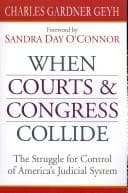
When courts and congress collide
"Efforts to check the power of the courts have come and gone throughout American history, from the Jeffersonian Congress's struggle to undo the work of the Federalists, to FDR's campaign to pack the Supreme Court, to the epic Senate battles over the Bork and Thomas nominations. If legislators were solely concerned with curbing the courts, Charles Gardner Geyh suggests, they would use direct means, such as impeaching uncooperative judges, gerrymandering their jurisdictions, stripping the bench's oversight powers, or slashing judicial budgets." "Yet, while Congress has long been willing to influence judicial decision-making indirectly by blocking the appointments of ideologically unacceptable nominees, it has, with only rare exceptions, resisted employing more direct methods of control. When Courts and Congress Collide is the first work to demonstrate that this balance is governed by a "dynamic equilibrium": a constant give-and-take between Congress's desire to control the judiciary and its respect for historical norms of judicial independence." "It is this dynamic equilibrium, Geyh says, rather than what the Supreme Court or the Constitution says about the separation of powers, that defines the limits of the judiciary's independence. When Courts and Congress Collide requires all of us to consider whether we are on the verge of radically disrupting our historic balance of governance."--BOOK JACKET.

