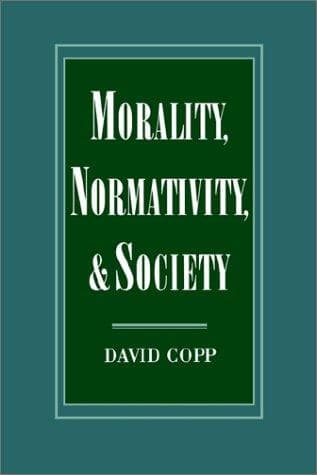
Morality, normativity, and society
Edición de la obra Morality, normativity, and society
| Autor | David Copp |
|---|---|
| Editorial | Oxford University Press |
| Fecha de publicación | 1995 |
| Lugar | New York |
| Idioma | inglés |
| Páginas | 262 |
| ISBN-10 | 0195078799 |
| OCLC | 30319866 |
| LCCN | 94012013 |
| Número de Cutter | C785m |
Under what conditions can moral claims be said to be true? Copp's book explores this question, starting from a new cognitivist theory of normative judgement - the "standard-based theory" - which offers a schematic account of the truth conditions of normative propositions of all kinds, including moral propositions and propositions about reasons. According to the theory, a moral proposition is true only if a corresponding moral standard is relevantly justified. At the heart of the book is a theory of the circumstances under which moral standards qualify as justified, the "society-centered theory." Copp argues that because any society needs a social moral code in order to enable its members to live together successfully, and because it would be rational for a society to choose such a code, certain moral codes, and the standards they include, are justified. The standard-based theory says, then, that corresponding moral propositions may therefore be true. Offering new perspectives on reason and rational choice, Copp's approach to morality and normativity raises a number of important issues in moral theory, as well as in metaphysics and the philosophy of language.