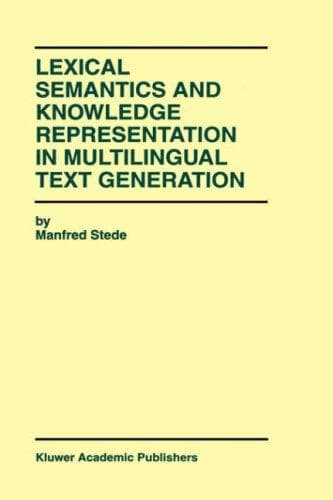
In knowledge-based natural language generation, issues of formal knowledge representation meet with the linguistic problems of choosing the most appropriate verbalization in a particular situation of utterance. Lexical Semantics and Knowledge Representation in Multilingual Text Generation presents a new approach to systematically linking the realms of lexical semantics and knowledge represented in a description logic. For language generation from such abstract representations, lexicalization is taken as the central step: when choosing words that cover the various parts of the content representation, the principal decisions on conveying the intended meaning are made. A preference mechanism is used to construct the utterance that is best tailored to parameters representing the context.
Readers with a background in artificial intelligence, cognitive science, knowledge representation, linguistics, or natural language processing will find a model of language production that can be adapted to a variety of purposes.