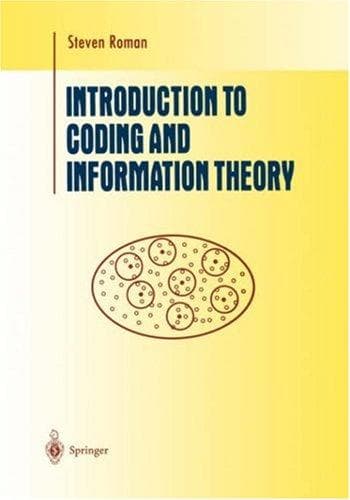
Introduction to coding and information theory
Edición de la obra Introduction to coding and information theory
| Autor | Steven Roman |
|---|---|
| Editorial | Springer |
| Fecha de publicación | 1997 |
| Lugar | New York |
| Idioma | inglés |
| Páginas | 323 |
| ISBN-10 | 0387947043 |
| OCLC | 34355037 |
| LCCN | 96011738 |
| Serie | Undergraduate texts in mathematics |
| Número de Cutter | R758i |
"This book is an introduction to coding and information theory, with an emphasis on coding theory. It is suitable for undergraduates with a modest mathematical background. While some previous knowledge of elementary linear algebra is helpful, it is not essential. All of the needed elementary discrete probability is developed in a preliminary chapter." "After a preliminary chapter, there follows an introductory chapter on variable-length codes that culminates in Kraft's Theorem. Two chapters on Information Theory follow - the first on Huffman encoding and the second on the concept of the entropy of an information source, culminating in a discussion of Shannon's Noiseless Coding Theorem." "The remaining four chapters cover the theory of error-correcting block codes. The first chapter covers communication channels, decision rules, nearest neighbor decoding, perfect codes, the main coding theory problem, the sphere-packing, Singleton and Plotkin bounds, and a brief discussion of the Noisy Coding Theorem. There follows a chapter on linear codes that begins with a discussion of vector spaces over the field [actual symbol not reproducible]. The penultimate chapter is devoted to a study of the Hamming, Golay, and Reed-Muller families of codes, along with some decimal codes and some codes obtained from Latin squares. The final chapter contains a brief introduction to cyclic codes."--BOOK JACKET.