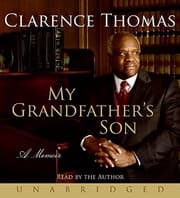
Clarence Thomas
23 June 1948 · 6 obras en el catálogo
Clarence Thomas is an Associate Justice of the Supreme Court of the United States, appointed in 1991 and serving as one of the longest-tenured members of the Court. His career spans law, public service, and judicial decision-making, with a jurisprudential focus often associated with textualism and originalism. Thomas was born in 1948 in Pin Point, Georgia, a small Gullah-speaking community near Savannah. Raised primarily by his grandparents after early childhood instability, he attended segregated schools in his youth during the final decades of Jim Crow in the American South. He later enrolled at the College of the Holy Cross in Worcester, Massachusetts, where he graduated with a degree in English literature. He went on to earn a Juris Doctor from Yale Law School in 1974. After graduating, Thomas entered legal and public service roles, beginning as an assistant attorney general in Missouri under then-Attorney General John Danforth. He subsequently worked in various governmental positions, including as legislative assistant on Capitol Hill and later in regulatory and administrative roles within federal agencies. In 1981, he was appointed Assistant Secretary for Civil Rights at the U.S. Department of Education, and in 1982 he became chairman of the Equal Employment Opportunity Commission (EEOC), a position he held for nearly a decade. Thomas was nominated to the U.S. Court of Appeals for the District of Columbia Circuit in 1990 and confirmed shortly thereafter. In 1991, President George H. W. Bush nominated him to the Supreme Court following the retirement of Justice Thurgood Marshall. His confirmation process became one of the most closely watched in modern U.S. history, culminating in a narrow Senate confirmation. On the Court, Thomas is widely regarded as a consistent advocate of originalist interpretation of the Constitution, often emphasizing the text’s original public meaning and expressing skepticism toward doctrines not explicitly grounded in constitutional text or early historical practice. He has written separately in numerous cases, frequently concurring in judgment but differing in reasoning from other justices. His opinions address a wide range of constitutional issues, including federalism, administrative law, free speech, and criminal procedure. Thomas’s judicial philosophy often emphasizes limiting the scope of federal administrative authority and reinforcing the constitutional separation of powers. He has also questioned the incorporation doctrine as applied through the Fourteenth Amendment in several writings, though such views are not uniformly adopted by the Court as a whole. His tenure has not been without controversy. Allegations raised during his 1991 confirmation hearings, particularly those involving Anita Hill, drew extensive public attention and contributed to national debate regarding workplace harassment and judicial confirmation processes. Despite this, Thomas was confirmed and has since remained a central figure in constitutional interpretation debates. Over the course of his career, Thomas has become an influential voice on the Supreme Court, shaping discussions around constitutional originalism and judicial restraint. His judicial record reflects a sustained engagement with foundational questions about the role of courts, the limits of federal power, and the interpretation of constitutional text in modern governance.